Search This Blog

Showing posts with label economics. Show all posts

Monday, September 16, 2024

Thorns and Thistles

 Be thankful for the

          thorns and thistles which keep

       you from being in love

    with this world.

     - Charles Spurgeon -

Hello dear friends!  I had never intended to write a post again, but  a rather odd thing happened the other day, I guess you could say it was an answer to a prayer.  You see, the other day I was thinking of something I wanted to tell you all (I've forgotten what it was) and during my conversation with my Heavenly Father, I said "Lord, if you want me to continue on with this blog, you will have to give me a sign, like someone leaving a comment."  Well, within twenty-four hours I received a comment from Old Fashioned Rose, so Old Fashioned Rose, if you are reading this, you are an answer to a prayer!  

These past several months have been a time of thorn and thistles here at Sweet Briar Cottage, as I am sure this year has been for you all also.  It began with the gardening season, it was such a cold Spring everything was so slow to germinate and many seeds needed to be planted and replanted.  I know a lot of you had very hot weather, but we can't complain here, on the contrary, there were quite a few times that found us reaching for a sweater in July and August.  What we did have, was a drought.  Most of our days were taken up with watering the garden and keeping the intense sunlight from blighting the vegetables.  BTW, we discovered that hanging mosquito nets over the plants, helped with that.  We bought  our netting at a garage sale, it was intended for hanging over a king-sized bed, it netted (no pun intended) quite a bit of yardage perfect for protecting the plants. So that was that.  Never have we worked so hard in the garden.  It took Ran, Jamie and me many hours everyday to keep it going.  But we were blessed.  While we didn't enjoy the huge yields we have in the past, but they were sufficient for our needs.  Our philosophy is to eat what the Lord provides, so if a crop fails or doesn't perform well, we just say it wasn't what He intended for us to eat.  Evidently, He didn't think we needed much in the way of cauliflowers or Brussels sprouts,  but now broccoli, was coming out of our ears. Ha!  Seriously though, we do take this conviction with the utmost solemnity, and it has stood us in good health for many years.  You know you are on the right track when you visit the doctor and he queries you on what you are doing to stay so healthy and takes notes.  But alas, we are getting downright elderly and there is no cure for growing old.  We have noticed that the days of being a weekend warriors are over for us.  Things still get done, but at a slower pace.

On a personal note, I have just been shutting myself off from the world.  Just don't seem to have the patience any longer for people that want to bring drama into my life. So I've been letting one-sided friendships slip away and even this blog, which always has its "contrarians"  (comments you don't see), has been put aside. The few friends that remain, tell me they are doing the same.  Do you feel the same?  I once heard a sermon by Tolver that spoke of a believer's path being a solitary and lonely one, and I am finding that to be true.  It is difficult to live in this world and not be of it.  But oh the peace, dear friends, that comes from such a life. 

SELF SUFFICIENCY

I a big proponent of being a self-sufficient as one can possibly be.  We grow all our vegetables and fruits, and Ran catches (he holds a "master angler" award from the Michigan DNR) most of our meat in the form of walleye, salmon, pike and bass.  Other than that, our protein comes from beans and nuts.  Once in a very rare blue moon, we will find lamb  or some grass-fed organic beef on sale and stock our larder.  And at Thanksgiving I do buy an extra turkey to can, but on the whole, we eat between  one to two pounds of meat a week for our family of three adults.  A lot less than the national average, the average American consumes over 224 pounds of meat a year.  Yikes! No wonder everyone is complaining about the price of groceries.  Meat is becoming a luxury item, that's for sure.  I just spied a grocery store ad for a sale on hamburger at $4.88 a pound.  Even lowly ground turkey is over three dollars.  I can remember for years it was a cheap option for meat at  ninety-nice cents a pound.  Even dried beans are selling for over two dollars a pound.  So I can understand how all this inflation is very scary for a lot of people.  

So anyway, I encourage everyone to get out there and grow some of your food, don't be discouraged by bad weather and nay-sayers.  At the very least, it's good exercise.  And get the whole family involved.  In our family we say, "if you don't work, you don't eat".  To grow a productive garden takes a lot of time. and work.  Too many people become discouraged if their first attempts don't produce.  The other day, once again, someone told me how "lucky" I was to have such a nice garden, and was bemoaning the fact that they weren't blessed with a green thumb.  I was too polite to say it, but what I wanted to say was that luck had very little to do with it.  I didn't see them out there hoeing at six in the morning before it got too hot.  I didn't take a week-long vacation and leave my garden to its own devices.  I didn't see them out there hauling buckets of water, or picking potato bugs off the plants.  I don't see them studying up on how to get rid of garden pests organically.  I don't see them composting, then carrying heavy shovels of compost into the garden to amend the soil.  Yes, I am blessed, but lucky I am not.  It definitely doesn't feel lucky when I'm standing in a ninety degree kitchen peeling and canning beets while they are sitting in the air conditioned living room watching TV.  So to get off my soapbox and get back to self-sufficiency, the other day I made a list of everything I would need to purchase for a year in addition to what Ran catches and we grow.  Here's the list:

2 gallons cider vinegar (canning strength)

1 gallon white vinegar (canning strength) 

12 pounds of cheese ( 1 pound per month)

12 pounds of shortening (for use in baking and frying)

1 gallon cooking oil (we use olive oil)

50 pounds of sugar (mainly to be used in making jams, jellies, and wine)

100 pounds of flour ( this may seem like a lot, but we bake everything from scratch and I only bake sweets once a week)

24 pounds of coffee (what can I say, we love coffee)

50 pounds oatmeal (oatmeal is our staple breakfast)

100 pounds dried beans (2# a week)

10-20 pounds cornmeal ( beans + a whole grain make a whole protein, thus beans and cornbread is a common meal among the poor)

2 quarts of molasses (no need for brown sugar add 1 tablespoon to sugar, plus black strap molasses has a lot of minerals in it and is very healthy for you)

Baking powder and baking soda, a couple containers

12 jars of organic peanut butter (a jar a month)

2 pounds canning salt (not just for canning but also for cleaning cutting boards and possibly for curing meat)

1 pound of cinnamon ( cinnamon is good for keeping your blood sugar level, hence we put a big spoonful into our oatmeal every morning)


Even at today's prices I think I could purchase these things for around a thousand dollars or maybe even a little less, if I shop carefully at the bulk food stores and our Amish discount stores.  And yes, if I really needed to, I could go without the coffee. Ha!  I could resort to my own herb tea, while tea isn't my jam, I have given some to several of my tea-drinking friends and the say it is very good tea.  Basically, I just put everything in my garden I know to be good for you into it; raspberry leaves, chamomile, peppermint, rose petals and hips, anise hyssop,  lemon balm, and dried blackberries and raspberries.  It's a pretty tea, if nothing else.  So any way, I hope the list helps you, if you live as we do.

 There you have it.  My camera bit the dust, so I cannot share with you any of my creative endeavors, but the period I have been away from blogging has been one of my most creative periods I have experienced in a long time.  Will I write another post some day?  I'll have to see how this one goes, I'm aware blogging is sort of a dying medium, and those that do read them prefer style over substance.  So will anyone even look at a blog without some sort of pretty photography?  Well, all that will depend  upon you dear  readers and the prompting of the Good Lord.  So whether we meet again or not, I  pray that you all have a peaceful and fruitful life!


Hugs

Jane

Thursday, March 23, 2023

Small Scale Maple Sugaring and Other Thrifty Doings

 Hello dear friends!  Happy Springtime!  Several of you have written and told me that you have had problems with subscribing and commenting on my blog.  I'm sorry about that, unfortunately, I am the least techie person on the planet, bordering on full-on Luddite status, so I cannot fix those problems, but I do appreciate you making an effort to let me know. I truly do appreciate all feedback, even the negative as long as it doesn't get abusive.  Anyway, with that out of the way, here's what springtime looks like in my neck of the woods:


Not the prettiest season.  No forsythias, no daffodils, no green grass, those things won't come until May, just mud and the remainder of the snow. It always looks so bad this time of year.  So that is the reality of living "up North".  But on a happier note, the robins have returned, and the morning was greeted with a cheerful chorus of birdsong.  They are surviving on the wild grapes and crabapples left on the trees until the ground thaws and they can get at their worms. 

Small-scale Maple Sugaring

I just read a news article that this year has been one of the best maple sugaring seasons Michigan has had in a long time.  We are gathering a gallon of sap a day from the one tap on the maple tree in our front yard the past few days. We already boiled down enough to make a quart and a half of syrup. This year was just an experiment to see how we could do this efficiently, but next year we will tap more trees and put more than a single tap in each.  Here's how our tap looks:

We inserted some tubing into the tap and then into a pop bottle, then Ran rigged up some wire to attach the bottle to the tap. Then when the bottle is three-quarters full, we put the sap in an enamel-lined pot and put it atop our woodstove, where it evaporates down to one-tenth of its volume. This way we are not wasting any energy, as the stove is being used to heat the house anyway.  After that, Ran takes the evaporated sap out and finishes the evaporating process on our rocket stove.
You can get all fancy-schmancy and measure the temperature of the sap to see if it is at the syrup stage, but we just eyeball it.  When it is the right consistency to run off of a spoon slowly and it's that maple-syrupy color, we bottle it.  I will probably "can" the syrup for long-term storage in pint jars.  I use the term "can" but it more like bottling the jars.  Sterilize you jars in a 275-degree oven for ten minutes, .  (Normally I do not recommend sterilizing jars this way, but you want the jars to be dry inside, so that the syrup doesn't mold.)  Heat you syrup to the boiling point, pour the hot syrup into the hot jars, leaving 1/4-inch headspace.  Place a lid that has been simmered and then wiped dry atop each jar and the screw the band on tightly, none of this fingertip tight business here, really jam the rings on.  Place the jars upside down on a soft dishtowel.  This should seal the jars. After the jars have cooled, turn them upright and check to see if the jars have sealed.  Any that haven't should be stored in the refrigerator for up to six months. I'm sure there's many articles on exactly how to do this out on the internet, if you want to do a bit of research, but it really isn't rocket science. Speaking of rockets, these rocket stoves are a wonder.  They take very little energy to get a large pot of water up to the boiling point.  We just use twigs we find in the yard and scrap lumber.  We've used our countless times when we have lost electricity for the umpteenth time every year. This is a purchased one, but again, there's lot of information on the internet on how to make one.  They are definitely a valuable tool to have on hand.

Taking Stock

March is the month that we take stock here at Sweetbriar Cottage.  We go through all our canned goods and see what we need to grow and preserve for the coming year.  More tomatoes for catsup and salsa but we are good on beets and carrots. (I'm still having nightmares about having the flu while canning those bushels and bushels of carrots.) And we definitely need to make more sauerkraut this year.  All the oddball canned goods and those that are reaching their expiration dates are put into a basket to be used for meals this month.  It makes for some interesting meals; I can vouch for that.  And we try to eat down our freezer, in anticipation of the coming fishing season.  My goal is to use only the freezer compartment of the refrigerator and not even use the small upright freezer we have (a goal I have yet to achieve). 

 It is finally warm enough to go up into the attic and straighten things up.  I can truthfully say, I needn't buy another skein of yarn or scrap of fabric for the rest of my life.  I will need to live to be a hundred just to use what I have, and that is after donating bags and boxes of yarn and bolts of fabric to the local thrift store.  I also go through my winter wardrobe and donate all the clothes that I have never worn all season and the ones that do not suit my lifestyle any longer.  There's no point in having pretty clothes that are not practical, I never go anywhere to get dressed up.  They are just taking up space and in a small home space is more valued than hanging onto things for sentimental value.  My thoughts on the whole matter are that it is better to pass on these pretties on to someone who might enjoy them, then it is to have them sitting in drawers going to waste.  Taking stock from time to time is a thrifty thing to do. After seeing all that I have, I can honestly say "enough is enough"!

But yet....

I say all that, but yet, it didn't keep me from taking a jog through the thrift store yesterday when I dropped off some donations. Ha!  I had this beautiful piece of an old overshot coverlet that I wanted to frame, so I was looking for a frame to cut down to fit the piece. And there it was!  For $5, less than what I'd pay just to have the glass cut.  I was going to paint the frame, but I thought the color brought out the golden browns in the fabric.  It took less than a quarter hour, for Ran to have it framed and hung.  

Even the mat worked out (it appears more bluish here than it actually is).  The only other thing I bought was a twiggy wreath for my door.  I toss my wreaths at the end of the seasons.  Usually, they look the worst for wear after a couple of months being battered about by the wind and the thrift stores always have more.  The one I bought cost 75 cents.  Speaking of twiggy wreaths, here's a woolen candle mat I made from some of my big box of wool scraps:
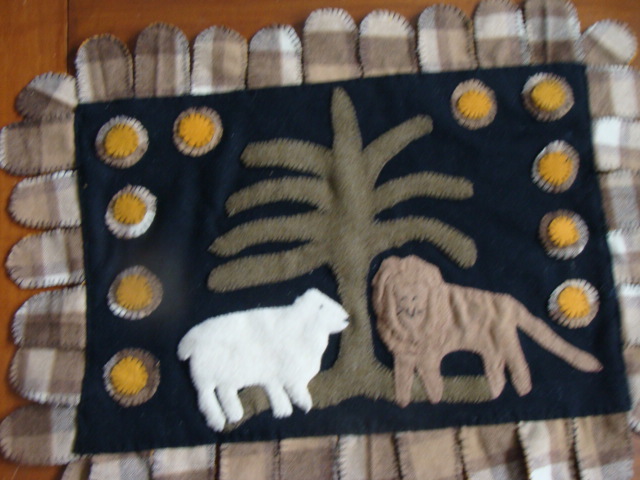
That was a fun one-day project.  And here's a penny rug I finished this month:

I am through with making those woolen tongues for a long while.  In March I decorate in a lamb and lion theme.  I don't decorate for Easter; all those bunnies and chicks are too cutesy for me. And I am not fond of pastels.  Besides, the lion and lamb have a Biblical connotation. Or so I thought.  I had a real Mandela-effect experience when I discovered that the Bible actually says, "The wolf will lie down with the lamb".  I thought it might be some modern interpretation, but I checked my grandmother's Bible that was published in 1911, and yep, it says wolf there too.

March Sales

March is a wonderful time to stock up on some items.  They've had great buys on corned beef.  At Aldi's I bought the cheaper cut for $2.99 a pound.  I would have bought some to can, when you can your meat it tenderizes the cheaper cuts, so don't be afraid to buy them for this purpose, but I still had plenty in my pantry from the previous year, so I didn't.  But I did buy two roasts, one we ate on St. Patrick's Day, and the other I roasted and cut into slice for sandwiches.  I still see corned beef on sale at Walmart.  

I saw lamb for less than $4 a pound at Meijers.  Unheard of price for lamb!  If I weren't being so lazy, I would buy some to can for stew.  Lamb is a rarity in this house.  I used to grind it and make gyro meat which I sliced and froze.  So nice when the cucumbers and dill are ripe for tzatziki sauce.  Oh, oh!  I'm talking myself into a chore!

And of course, ham and eggs are usually on sale this time of year.  I haven't checked the prices, but just a quick glance, I have noticed that the prices on eggs are going down. You can really make a ham stretch.  One of our favorite ways is with this ham and egg pie. Then there's always ways to use it in soups and omelets. Take all the little scraps and grind them up add some onion, mayo, and dill relish and make a sandwich spread.  And when you get down to the soup bone there's always a nice old-fashioned boiled dinner (with lots of cabbage which is on sale this month).  Goodness!  A family could survive an entire month on one bargain Easter ham!

A Question Posed

Recently, someone posed the question is self-sufficiency and preparedness Biblical?   This is usually followed by the verse about the lilies of the field.  I'd say, yes, while we depend on God to provide for us, He also give us knowledge and discernment.  I can point to just as many verses and parables about preparedness. We all read the news about bank closures and interest rate hikes; they should be telling you something about where the economy is heading.  It would be foolhardy to not watch your pennies a little more closely, in my opinion.  My attitude is not to go at preparing for hard times in a fearful manner, by going to grocery store and hoarding up enough food and making your home into a bunker, but it won't hurt to have some extra things put aside.  These days, no one can be truly self-sufficient.  Even centuries back, people were still dependent on others; millers to help grind the grain, neighbors to help shuck the corn, threshing teams at harvest time, not to mention most had large families that pulled together.  I dare say that a lot of those "preppers" I see on YouTube will find that all their well-laid plans are just that, when they have to grow enough feed for all that livestock and harvest it with a scythe because fuel and parts are not available for their tractors. Or if they have to haul buckets of water from a stream for that herd of cows.  They'll be downsizing their gardens when they have to turn over the soil with a shovel and till it by hand.  And what does one do when a drought occurs?  Or a flood wipes out your crops?  Then I dare say, we are not as self-sufficient as we thought, so we needn't be so smug about it.  Self-sufficiency is a goal, but I'd say we still need to have God's blessings to ever achieve any facsimile of it. Yet, I still say it is better to at least try attempt to live as independently as possible, rather than to rely on the good graces of others, or worse yet, the government, to provide for you, realizing that every tomato you pick, every piece of firewood you stack, every drop of water you drink, is a blessing and should be treasured and not wasted. What say you on the subject?

So anyway, that's it for this month's Thrift Thursday at the old Zempel boarding house.  Dear Regina, I hope this helps, and thank you for urging me to write a post!

Hugs
Jane


Tuesday, March 31, 2020

Hard Times in the KItchen

Hello dear friends!  Today I got quite a jolt of reality; on my drive to get gasoline, I noticed a very long line of cars.  What on Earth?  They were queuing up to pick up free food just outside of our city limits.  Firstly, I didn't even realize we had that many locals, and second of all, it's only been a few weeks of  being shut in, can there possibly be that many people in dire straits already?

Are you feeling the pinch?  Here's some ideas that have gotten me through many a rough patch.

LEARN HOW TO MAKE A BASIC WHITE SAUCE

Here's a post I wrote about this very functional and basic culinary skill, that everyone that wants to be frugal, should know.  A basic white sauce can turn anything into a casserole.  Today I made an egg casserole with it by adding a bit (about 1/2 C) of cheese to this sauce, sautéing up some onions and my home-dried peppers in some bacon grease and scrambling up six eggs.  All was combined, poured into a greased 8-inch pan, topped with some cracker crumbs and baked for 25 minutes.  Made a nice lunch for the three of us.  Last week I wanted to make some lasagna, but didn't have any ricotta cheese and had no desire to go to the store, so again the basic white sauce came to the rescue.  I added some garlic powder and parmesan cheese (the kind that comes in the canister, not the expensive cheese aisle type) to it for flavor.  Although the lasagna was a little runnier than with the ricotta cheese, we actually preferred it.

GET OVER THE "NO CARBS" FAD

I know many prefer and some cannot eat carbs, but they are what fills you up.  Maybe you won't want to eat these meals, but when you are trying to feed children on a budget, there's no other way.  In this
post I write about potatoes and give two very basic recipes for potato pancakes and potato soup.  Two recipes that have gotten my family through some very dire straits of our own.  A baked potato with cheese sauce (again from the basic white sauce) and some broccoli makes a thrifty lunch. Hamburger or sausage gravy served over potatoes, rice,  or a slice of bread can stretch a pound of meat to feed several.  An egg by itself might not be very filling, but throw in a couple of slices of toast or a bagel and you've got something that will stick with you. Oatmeal has always been one of the most economical and healthy breakfasts known for centuries. Popcorn (the old-fashioned kind popped in pan with a dab of oil, not the microwave stuff) makes an inexpensive snack and is a good source of fiber.

LEARN TO LOVE BEANS

Beans are an inexpensive source of protein and are easy to store. Besides being eaten on their own, you can stretch your meat by adding more beans in your chili, sloppy joes, mashed ones to meatloaf, etc. Here's a post on how we prepare our basic refried beans.  They are delicious.  And another with basics how to use beans and more meal ideas.

USE IT ALL UP

We try not to waste anything.  When we finish with our chicken we scrape the bones into a pot and with the potato and carrot peels, the leftover vegetables, etc. we always make broth, which I can, but can be frozen.  You can do this with just vegetables or other meats also.  I never buy broth.  I already mentioned that I use the leftover bacon grease to sauté onions and peppers for omelets.  Stale bread is always turned into bread puddings, breadcrumbs, French toast or garlic bread.  You get the picture. At the very least, scraps should be made into beautiful compost for you garden.

Well, my computer has already messed up this post several times, so I better get it posted. Hope this helps!  We'll see how it goes, if you'd like more posts, let me know.

Hugs
Jane


Sunday, October 2, 2016

RECESSION PROOF YOUR LIFE

Hello dear friends!  Happy October!   This is my second attempt at writing this post, I was fairly far along  in writing it, when my finger slipped and hit a button and the entire thing disappeared!  Did anyone else's blog list disappear this week?  Oh  my computer woes!  Anywhoo, we're having a beautiful Autumn day today.  It's what I call a Benediction day, you can feel God's face shining down on you and giving you peace. 

And peace is what I need, as I read about what is going on in the world economic-wise.  As of October 1st, the Chinese Yuan is now a reserve currency.  (If you are unaware of the significance of this, you can read my post about the meaning of the petro or reserve currency  which explains it pretty easily.)  Deutsche Bank is teetering.   Just before the elections in November, the Federal Reserve will vote on and probably raise the interest rate and many of you recall that the stock market dropped like a stone the last time they tried to raise it forcing them to rescind the action.  And oh yes, we've been riding the biggest bubble of all, the stock market bubble, for far too long, which will make the tech and housing bubbles look like child's play in comparison.  All of which makes for a rather gloomy forecast for the near future. Just saying, that it doesn't hurt to have some bags of beans and rice stocked in the pantry and some cash hid under the mattress.  You'll have to decide for yourself what to do, but I do know that no one was ever hurt from having some extra food stashed away.  You can always eat if nothing happens.

Recently a comment left by Sharon, reminded me that I have lived through a major recession before.  It's funny how time has dimmed the memories of those worries and fears. In the late 70s and early 80s when Ran and I were just starting out, unemployment was high, inflation was even higher and if  we were going through an oil embargo, that significantly raised the cost of living.  If you were fortunate to have a job, it was likely that your wages were frozen and even if you did get a 3% raise it didn't keep up with inflation.  So basically each year you were getting poorer, unless you had lots of money in the bank, then you could earn 13% interest on your savings account, unfortunately we and many people didn't have any savings.  I remember friends that were lucky enough to have both spouses working, spent their money like it was water, because next year the same money would  buy 20% less. It was a fearful and hedonistic time back then, depending upon which side of the ledger your fortunes fell.

Yet through all the gloom, it was one of the happiest times of my life.  So much of what I learned about thrift stems from that period.  I have to laugh now at some of the measures I took to put food on the table back then.  I remember making a soup with one pork chop.  I boiled the meat to make the broth, added the vegetables, then took the meat out and reused it to make another batch.  Now that is extreme tightwaddery!  And I won't mention the many, many meals of potato pancakes. When times are really hard, there are only three main concerns for your money; food, shelter and transportation to work.  And I dare say, many times food was given up in favor of gasoline and rent.

So what's to be done about hard times?   First give up everything but the essentials.  You know, you really don't need a fancy schmancy phone.  I still manage to communicate with others with my cheap little pay-as-you-go phone and MagicJack.  You can still create happy memories for the children without spending money on vacations and elaborate  parties.  You don't need cable TV.  I live without it, and still manage to know what's going on in the world. When you get down to just the basics, figure out how to cut down on them.  Right now, I'd be scouring the thrift stores and estate sales looking for good woolen blankets, so I could cut my heating bill this winter.  I'd stock up on beans, rice, potatoes and flour.  I'd be searching the internet for recipes for meals made from inexpensive ingredients.  Oh!   And by the way, when you find those recipes, copy them.  Who knows if you'll be able to afford the internet in the future.  Back in the day, I made a simple notebook of recipes from the pantry, culled from sources such as the Grit and Cappers (back when they were good magazines), old church cookbooks, and family  and friends.  I still turn to that booklet when the budget is tight.  Many of the recipes that I write in my Recipes From the Pantry posts are pulled from those pages. Use the internet while you have it, to learn how to do things for yourself, such as; haircutting,  sewing, food storage, foraging etc.  YouTube is a gold mine, there are so many tutorials on it.

But most importantly, strengthen your faith.  To quote Abraham Lincoln, "I have been driven many times to my knees by the overwhelming conviction that I had nowhere to go. My own wisdom and that of all about me, seemed insufficient for the day."  The best lesson I learned from that time period was, as a Christian, I was to live in this world and not be of it.  I'm sure the other major faiths have a similar outlook.   That is why I can be content and joyful, in adversity.  Things such as a big house, fashion, the latest gadget, a new car, etc. are only ephemeral things,  my treasure is not in this life.  This is going to sound very strange, but from a very young age, I felt that when it comes to thriftiness, God has whispered in my ear and told me to pay attention.  That is why, since my first memories, I have been studying how people lived through hard times.  When older family members spoke of the Great Depression, I listened.  I read novels such as The Grapes of Wrath and A Tree Grows in Brooklyn like textbooks, studying how the characters survived.  I've read and still prefer to read biographies and autobiographies of people that suffered through wars and famines.  And pioneer tales also.  Anything to squeeze one more bit of knowledge out of the pages.  And I can tell you the two main concerns were always food and shelter.  So if the economy takes a tumble that would be my main focus.  Just always remember others have lived through times of trouble and you are just as strong as they are, you'll get through them also.

SO

Even in the hardest of times, there is joy.  Hard times can either bring people closer or pull them apart.  One of the ways to draw family closer is by creating your own traditions. We have a few Autumn traditions here, one is that we get out our Fall decorated mugs.  They are just cheap mugs that we bought at the dollar store, but every year we look forward to the first cool day, to bring out the Fall mugs.   The other tradition is that we hold our own Oktoberfest on the first Sunday in October.  I always serve Alsatian pork roast made form our homemade sauerkraut and dress the table in our finest.  Pork is always cheap this time of year.  I bought a lovely sirloin roast from Aldi's for $1.99 a pound.  Never having bought meat from them before, I was impressed.  It was one of the most tender roasts I've ever had.
The carrots, onions, herbs and potatoes  all come from our garden, so it is also a true harvest  and thrifty meal.

GARDENING

As a side dish we had one of our Australian Butter squashes.  This is a new variety to us this year and we'll definitely be growing them next year.  They are a squash-haters squash,  very mildly flavored.  Except for leeks and some flowers, our vegetable garden is now put to bed for the winter.  While out cleaning and tilling, Ran discovered  a cluster of grapes that I had missed when I was harvesting them for juice.  It was just enough to make three little grape tarts, which we had for dessert.  I wrote the recipe in a reply to Vickie, but thought you might like to have it also:

Concord Grape Pie

Unbaked pie shell
4 1/2 C. Concord grapes
1 C. sugar
1/4 C. flour
2 tsp. lemon juice
1/4 tsp. salt
streusal (recipe follows)

Wash grapes and remove skins by pinching at end opposite stem. Reserve skins

Place pulp in a saucepan and bring to a boil. Cook a few minutes until pulp is soft. Push pulp through a strainer to remove the seeds.

Combine the pulp and skins. Stir in the flour, sugar, salt and lemon juice. Pour into the crust. Top with streusel and bake at 425 degrees for 35-40 minutes or until the fruit begins to bubble.

Streusel:

combine 1/2 C. oatmeal,, 1/2 C. brown sugar, 1/4 C. flour, 1/2 tsp cinnamon. Cut in 1/4 C. butter until crumbly. Sprinkle over the pie.


THRIFTY THINGS WE DID THIS WEEK

Made vegetarian chili from the last of the tomatoes and peppers before we pulled them.  This made a huge pot, enough for three days of meals.  And it cost us nothing as everything came from the garden.

Ran cut Jamie's hair.

Our friend Mary brought us a bunch of fruit.  Has anyone heard of cotton candy grapes?  They were wonderfully sweet.

A thrift store in the area had a sale on all their clothing for 99 cents.  I found several skirts and a few tops to put away for next Summer, which I really needed.  My Summer clothes are deplorable.

Bought a 10 pound head of cabbage for $1.49.  The price was the same no matter what size of head you picked, so I picked the biggest.  Will make sauerkraut from it this week.

Made up some spaghetti sauce from the last culled tomatoes.  Froze it as there wasn't enough to bother canning.

Saved the seeds from the Australian Butter Squash.

Started knitting a hat from my never ending yarn stash.  I'm hoping it will be enough, otherwise I'm going to have to get creative!

Made grape tarts from the last of  the Concords.

Ran made some spoons from the free black walnut wood our neighbor gave us.

So that's it for another week at the old Zempel boarding house!   I hope that you all have a wonderful golden Fall week!

Hugs
Jane


Sunday, July 10, 2016

SMALL ECONOMIES

Hello dear friends!  Staying cool?  I won't rub it in by telling you that the weather here has been delightful.  Could do with some rain, but pretty perfect overall.  We've been staying up late to study the stars.  Below are two pictures that my son, Scott, took of the night sky.
  The pictures weren't photo-shopped, that's what the sky  actually looks like.  One of the many reasons I love it here.  These are pictures of our little guest shed that Jamie and Ran built.   I think it looks like a fairy tale illustration, as does the delphiniums and hollyhocks growing by the door.
If you want to have a big impact in your garden, grow hollyhocks.  We have some in the backyard that are over nine feet high.

GARDENING

We're a finally starting to harvest vegetables in the garden and are relying on it for most of our food once again.  Been a bumper year for peas, which I blanch and  freeze because no one likes the canned ones.

So far we've frozen about a gallon of them.  I first freeze them on cookie sheets so they don't stick together before putting them in freezer bags, then it's easy to just portion out as many (or as few) that we need for soups and pot pies.

Other crops that are being gathered are broccoli, cauliflower, lettuce, spinach, green onions, and soon we'll have zucchinis.  Getting rather tired of cauliflower, but we had this interesting recipe today for cauliflower cheesy bread to use some up.  It was very good and great for those of you that are trying to eat gluten-free.  We served ours with some of our home-canned spaghetti sauce.  It was a hit.

CANNING

Well, the birds are just taunting us by eating all the cherries on the bottom branches and leaving those that we can't reach at the top.  I finally gave up.  Cherries were on sale for $1.79/ lb, so I bought about 15 pounds and canned 8 pints of cherry juice (it can be diluted to make more)  using my steam juicer.  Once the juice was extracted, I had a lot of mash left over that I couldn't bear to waste, so I plopped it into a jelly bag and extracted enough juice to make six half-pints of cherry jelly.  BTW, cherry juice is very good for inflammation, particularly gout. People always tell me that they wish they knew how to can.  Well, no one taught me.  I learned by reading how-tos and by following the instructions that came with the canners.  How I would have loved to have had YouTube back then!  Just to say, that if you really want to learn something, there's no excuses now days.  Most wishes can be fulfilled by dint of hard work, I've discovered. 

Basic Jelly Recipe

3 1/2 C. fruit juice
5 1/4 C.  sugar
3 Tbsp. pectin

Place fruit juice and pectin in a large pot and bring to a hard boil (a boil that cannot be stirred down)  for 1 minute.  Add the sugar and bring to a hard boil.  Boil an additional 1 minute.  Place in sterilized jars, leaving 1/4 inch headspace. Place lids and caps on jars.  Process in water bath for 15 minutes.

Oh!  I almost forgot!  Eggs were 60 cents a dozen, so I bought five dozen and froze them for future baking.  To freeze eggs, you simply whip them up and pour them into ice cube trays and freeze.  Then just pop them out and place in a freezer bag.  When you want to use them for baking (I wouldn't recommend them for eating)  just thaw out and use as you would any egg.  The trays I used were a bit smaller than a large egg, which is ok, because most recipes will work with smaller eggs, or use two  cubes for one jumbo egg. Now I'm all set for eggs for the rest of the year for just three dollars!

SMALL ECONOMIES

After last week's craziness of entertaining family and friends, I'm happy to get back into our thrifty lifestyle (we spent more on going out for ice cream then I spend on two weeks of groceries!).  Rarely do we have a day where there's a monumental savings or a windfall, like buying a scarf for a dollar and selling it for $179, or saving several thousand dollars on a car purchase, but every day we make an effort to save.  It can be as small an effort as using one egg in a cake recipe instead of two, or sitting a while longer in the evening before flipping the light switch on.  I believe it is all those small economies, that in the long run have enabled us to put our children through college without them being indebted to school loans, and retire early.  We definitely  weren't born with a silver spoon in our mouths! Some of the things we did this day to save money were to eat a simple meal from the garden rather then give into the temptation to buy something at the grocery store or go out to eat, open the windows and use a small fan, rather than use the air conditioner, hang our clothes to dry out on the line. (and reuse the wash water for plants), baked two things in the oven at the same time so the house wouldn't be heated twice and use half the electricity.  You get the picture. It the little things in life that have the biggest impact.  Once you start doing them, they become second nature and before you know it, you have built nice little nest egg!  Every day we try to do at least one thing to save a dollar. Some days the savings comes from not giving into the temptation (there's a lot of temptation out there!) to spend money and making do with what we have; mending small holes in nightgowns and work clothes, settling for a meal comprised of pantry and garden items when I'd really rather have fish, walking to the post office when it would be faster and a lot cooler to take the car, etc.  Basically trying to differentiate between a need and a want. I've discovered over the years that thrift and hard work are synonymous.

THRIFTY THINGS WE DID THIS WEEK

Canned cherry juice.

Canned cherry jelly from the left over mash.

Frozen about a gallon of peas from the garden.

Bought eggs for 60 cents a dozen and froze them.

Turned off the air conditioner and used a small fan in the window instead.

Harvested cauliflowers, broccoli, lettuce, peas and spinach from the garden.

Cooked over the fire  outside to keep the heat out of the house.

Amused ourselves by star-gazing. 

The usual things of eating from the garden, washing our clothes in the old wringer washer, reusing the water,  hanging the clothes to dry, walking rather than driving, etc.

Well, that's it for another week at the old Zempel boarding house!  I hope that  you all have a delightful week filled with thriftiness!

Hugs
Jane


Sunday, July 12, 2015

Sweet Briar Cottage Journal: In The Good Old Summertime

Hello dear friends!   Hope your week went well for you!  We are finally getting our summer, a day late and a dollar short, but we'll take it!   There's so much excitement in our garden, as flowers are starting to bloom and vegetables are being harvested.  Everything is so tall this year!  The hollyhocks are well over six feet tall.  Here's the ones that we planted by our shed:
Don't they look like they belong  in a fairytale?  These were planted from free seeds that I gathered  from a neighbors house.  I love the old-fashioned cottage flowers the best.  Even the bee balm is towering over the hive!
We do our best to keep the bee population happy.  And here's the lilies behind the garage:
These are bulbs that I get at the 75% off sale at the end of the gardening season at the big box stores.  If you want to add value to your home, planting a flower garden will certainly do it.  And by starting flowers from seed, and buying discount bulbs and plants, it can be done quite frugally.  A neighbor remarked the other day that we have our own Paradise right here on earth, and we would have to agree!

Gardening is one of the things my husband and I like to do together.  He takes care of the vegetables and I do the flowers.  It's a happy marriage.  Speaking of marriage, we celebrated our thirty-seventh anniversary this week.  Ran made me this replica of a colonial bride's box to commemorate the occasion
More and more our home is becoming furnished in things that Ran builds.  I sew all the curtains, pillows, and tablecloths.  It's a very personal space.

SECRET TO A HAPPY  MARRIAGE

People have asked us what's the secret to a happy marriage and I always refer them to  this Bible verse:


  4 Love is patient, love is kind. It does not envy, it does not boast, it is not proud. 5 It does not dishonor others, it is not self-seeking, it is not easily angered, it keeps no record of wrongs. 6 Love does not delight in evil but rejoices with the truth. 7 It always protects, always trusts, always hopes, always perseveres.

~1 Corinthians 13:4-7~

CRAFTS
Speaking of labors of love, I finally finished granddaughter Tatianna's  sweater.  When she  begged me to make a sweater like her favorite cartoon character, Mabel Pines from Gravity Falls, I had no idea what I was getting myself into.  There isn't a pattern for it, so I had to design my own..  And I have to say, knitting that hot pink color gave me a headache! Ha!
Now that it's finally finished, I can go back to knitting something in a nice earthy color.  I'm unraveling a Merino wool sweater that I bought at the year end sale at our Thumb Industries Thrift Shop for seventeen cents (that's the sleeve).

HOW TO RECYCLE A KNIT SWEATER
First, only use sweaters of good quality wool.  Look at the seams and look for those that are sewn and not overlocked.  Crew necks work best because you can use both the front and the back.  Undo the seams and lay flat.  Cut straight across at just below the armholes for the front and back.  On the sleeves cut across at below the armhole. Starting from the top , unravel.  Have patience, sometimes it takes a few rows to get to the point where the sweater will unravel smoothly. Where else can you buy a skein of Merino wool for seventeen cents?

CANNING

Our butcher had a good deal on boneless, skinless chicken breasts this week,  $1.89/ lb.  So I canned up eight  pints.
When people ask me questions about canning I always refer them to Jackie Clay's blog . That woman is a canning wonder!

ECONOMICS AND PREPPING

So have you been following what's been happening in Greece and China?  Did you now that the United States has a bigger debt to citizen ratio than Greece?  So why's  the U.S. dollar doing so well?  Because compared to other countries ours looks like the safest place to park your money.  Plus our markets are being artificially propped up by the Federal Reserve and the International Monetary Fund (IMF).  But it won't last forever.  Liquidity is drying up and banks are starting to limit credit, particularly in Europe.  What does that mean to you?  Well, take a can of beans for example, before that can of beans reaches the store shelves, it goes through a series of credit transactions; the farmer, the elevator, the manufacturer, the trucker, the store employee, etc..  If one of those credit transactions freezes up, the food doesn't reach you.  So stock up now.  Besides, what does it hurt?  With the prices of groceries inflating, it's a good investment.  All of the economist are predicting a crash in the fall.  Historically that's when they happen.  I'd rather err on the side of caution than be a day late and a dollar short. Wouldn't you?

DON'T BUY IT, MAKE IT

OK. I admit it, I love potato chips.  Or I should say , I loved potato chips.  I hadn't eaten any for months, but I bought a small bag the other day and they were so salty and greasy, I  couldn't believe I ever liked them.   Plus they cost what? About three or four dollars for a bag.  That's a lot of money for ten ounces of potatoes!  So we figured out how to make our own healthier baked potato chips.

Homemade Baked Potato Chips

Slice the potatoes very thinly.  And immerse them in a bowl of cold water for a few minutes.  Rinse off the potatoes.  Throw the potatoes in a pan of boiling water.  Time them once the water begins to boil again.  Boil for 1 minute.  Throw the chips in a colander and rinse with cold water.  Pat dry with a towel.  Coat with 1-2 tablespoons of olive oil until evenly coated.  Spread on a  parchment paper lined baking sheet, making sure they don't overlap.  Bake at 400 degrees until the chips start to brown.  Watch carefully, once they brown they brown really fast.  Remove from the oven.  Remove all the crispy ones and return the ones that need to bake a bit longer to the oven. Remove.  Sprinkle lightly with salt.  Tasted great and they were free, as we grow our own organic heirloom potatoes!

THRIFTY THING WE DID THIS WEEK

Harvested peas, broccoli, peppers, cauliflower, strawberries, and raspberries from the garden.

Dried cauliflower and broccoli

Canned 8 pints of chicken.

Unraveled a thrifted sweater for the yarn.

Finally found a cast iron pot with legs and a flat lid for our campfire cooking at a good price at an estate sale ($15).
Put it to use right away.  Fun and economical.

We had to travel to the big city to do some banking so to make the trip worthwhile we stopped in at a huge thrift store.  I bought 3 Ralph Lauren sweaters, a Ralph Lauren skirt, an Eileen Fisher sweater and a really cute vintage corduroy skirt for $13.  They were having a sale and several of the items were only 69 cents!  Have  most of my fall wardrobe now.  Which is good, I really got sick of my fall and winter clothes last year, when we had cold from September through mid-June.

I also bought a like new winter coat at a garage sale for $5.  I'm so tired of my gray one.  I've had it for several years.

We've been diverting our washing machine water to a bucket and using it to flush the toilet and water the flowers.  Also using the dishwater and the water left over in the canner.  Or water is so expensive here, mainly because the charge 5 times the water amount for the sewer, so by reusing the water, I hope to beat the system.  Especially when you consider that most of our water use comes from watering the garden which goes into the ground and doesn't even use the sewer.

Ate from the garden and a had  lot of meatless meals.

Plus all the usual things that you are probably tired of reading about!

Well, that's it for this week.   If you have a question or just want to say hello, please leave a comment.  Let me know what you are doing to make end meet.  I love learning new thrifty  ideas!  I also love to meet  like minded people.  I'd love to hear from you!

Later Tater!

Jane


.

Sunday, May 3, 2015

SWEET BRIAR COTTAGE JOURNAL: MAKING THE MOST OF WHAT YOU GOT

Hello dear friends!   Hope you all are doing well.  May has arrived, and with it, the daffodils!
Each year we buy one hundred bulbs from the big box store and plant them in long furrows.  We are hoping that eventually they will spread and our entire orchard will be covered in them.  The lungwort (ugly name isn't it?) has also blossomed.
Poor baby was trapped under the woodpile, so I'm tickled pink that it has survived.  For years I have been trying to plant some pale yellow primroses with the lungwort, a combination  I saw in  The Cottage Garden, one of my favorite books for garden inspiration. Unfortunately, between the guys stacking wood on them and Georgie napping on them all summer long, they haven't had much of a chance.  But maybe some day!  Isn't the sky a pretty blue?

We had our first batch of asparagus for lunch today.
  I think the best way to eat asparagus is to roast it.

How to Roast Asparagus

Preheat the oven to 400 degrees.  spread you stalk on a roasting pan.  Drizzle with olive oil (be stingy with it, it doesn't take much) .  Sprinkle with kosher salt and pepper.  Roast for 20-25 minutes until the stalk are tender.

"Happiness is making the most of what you have and riches is making the most of what you've got."
                                     ~Rosamunde Pilcher, The Shell Seekers~

In the spirit of making the most of what I got, I baked some Rhubarb muffins today.  One of the principles of a simple thrifty lifestyle is to use what you have and be grateful for it.  No use longing for some exotic imported fruit when there's plenty of rhubarb in your own garden! (Now if I could only learn to love black currants!)
Rhubarb Muffins

2 C. diced rhubarb
1 1/4 C. flour
1/2 tsp.  baking powder
1/2 tsp. baking soda
pinch of salt
1/4 tsp. nutmeg
1/2 C. buttermilk
1/2 C. brown sugar
1/4 C. oil
1 egg
1 tsp. vanilla
1/2 C. chopped nuts (optional)

Combine flour, baking powder, baking soda, salt, nutmeg and brown sugar in a large bowl.  Stir in the buttermilk, oil, egg and vanilla until just combined  (batter will be lumpy) . Stir in the rhubarb and nuts.  Divide batter between 8 greased muffin tins.  Bake at 375 degrees for 20 minutes, or until a cake tester comes out clean.

I wasn't expecting to like  these muffins as much as I did. After all,  I usually like to combine strawberries with my rhubarb, and in truth it is the strawberries you are mostly  what I enjoy tasting,  but these were really quite lovely.

Speaking of lovely things, I was the winner of my dear friend Rainey's  giveaway.  A sweet little embroidered heart.
It goes perfectly with all the zinc and tin that I collect.  Thank you Sweet Rainey! (The picture doesn't do it justice)

On Friday the annual M-15 garage sale trail was held.  We left at 7:00 AM and didn't arrive back home until 6:00 in the evening.  We packed our lunch and a thermos of water and the only costs besides the goodies we picked up was $16 for gas.  Where else can three people have so much fun for  $16?!   Here's a picture of some of the treasures we found:

A cute little zinc bucket that I plan to plant white geraniums in and place on a bench next to the door. Some really nice enameled pieces with measurements in grams and ounces that we will use for making soap.  The pieces were made in Austria.  The Austrians and Germans make the nicest enamelware!  Also found a cute prim basket for fifty cents and an adorable small yelloware  bowl. The old quilt came out of "free" box, it has some holes and stains, but I plan to make a runner and pillows with it.  An old marmalade crock to hold spoons on the sideboard and a nice smallish cast iron Dutch oven.  I want to do more campfire cooking this summer, so we have been on the lookout for cast iron pieces.  This one isn't too bad, it had just a tiny bit of rust that came off when I washed it with a scrub pad, but if you find rustier pieces, don't be afraid to by them. Here's how to revive old cast iron:

How to Restore Old Cast Iron Pots and Pans

With sandpaper, sand the rusted spots until you get down to raw metal.  If you have a really  rusty piece, you can use one of those attachments that fit on your drill.  Wash and dry your piece well.   Coat the piece inside and out with a thick coat of shortening.  It's essential that you get the shortening into all the pores of the metal.   Next, make a good roaring fire in you firepit  (some people do this step in a hot 450 degree or hotter oven, but the pans get really smoky so do that at your own peril and make sure you put something under it to catch the fat or you will have a fire).  Throw the pot in the fire  and let it get all smokey (it might even start to catch on fire, that's ok) After it stops smoking, remove from the fire.  Let it cool.  Clean out the ashes with a pot scrubber.   Wash  and dry well. Pour some vegetable  oil on a rag or paper towel and coat the surfaces before storing.

Cast iron is a good investment.  It wears like, well, iron!  I have a frying pan that came from my grandparent's  that is almost ninety years old, (one of the things that they rescued from the farmhouse when it burnt down in the 1920s) that I've used almost every day of my married life and it will probably be working long after I'm gone.  The more you use cast iron, the better it gets. Some people say you shouldn't wash it, but I do. Just make sure it's good and dry before putting it away.

How To Use Paint

I love old things!  I guess you could say that my decorating style is primitive/Early American.  The more chipped up and weathered looking the more I love it.  Here's a picture of an old piece of junk that we found at a garage sale, that we made look even junkier! Ha!
Paint is a wonderful  inexpensive way to make your home your own.   Like I said, I like primitive, so I use a lot of milk paint colors and sand away for the worn old look, but if you like shabby chic or cottage style, white and pastel colored paint is all it takes to transform garage sale finds into treasures. We also mix all the paint colors for our walls, using paint we have on hand, the discounted mistinted ones from the hardware store, those we can find at estate sales and the Habitat For Humanity stores, and sometimes people will give us their old paint.  When you mix your own colors, make sure you make enough to do the job plus extra for touch-ups.  Start out lighter than you think you want, paint always dries darker.  If a color is too bright, you can dull it down by adding a touch of color that is opposite on the color wheel.  Once Ran came home with some paint that he said was sage green.  I took one look at it, and instantly thought of Kermit the Frog.  So we kept adding red to it, to calm it down. Eventually we ended up with a mystery color.  Everyone that saw it, thought it was a different color.  Some thought it was blue, others green and still others saw it as gray.  It was a really soothing color and went perfectly with the soft yellow draperies and the yellow pine floors and furniture.  I just loved it!  Too bad, we'll never be able to recreate it. Here's a picture of the walls in our bedroom that we "custom" mixed. 


 My photography doesn't do it justice, but it is the nicest country cream color.  You'd be surprised at how many colors besides white went into the mixture!  By the way, one of the rites of spring is to replace all the lampshades with these vintage bird ones.  All garage sale finds.

Make The Most of What You Got

Patchwork is one of the coziest things in the world.  This week I made this little patchwork pillow for the living room, from scraps in the good old scrapbag.
I delight in using up the tiniest of scraps.  Of course, I never make anything bigger than pillows and runners because I like complicated patterns with a gazzillion pieces.

Last summer Ran and Jamie built a little guest/storage cottage.  It's a basic little box shape building.  So we wanted to gussy it up a bit. 

One day, I spotted an old house with cute little overhang, so we took pictures and Ran copied it.  Really don't care for the orange door but Ran loves it, so  I plan to plant tiger lilies at the foundation to tie it into the landscape.  An inn around the corner has tiger lilies and Shasta  daisies planted by the entrance and it makes a really sweet plant grouping.  Always keep your eyes peeled for new and inexpensive ways to add your own touch to your home.  If your are fortunate enough to have a home, enjoy it! 

"But a wife's ministry of mercy reaches outside her own doors.  Every true home is an influence of beauty in the community where it stands."
~ J.R. Miller~

Let's Get Serious

I got so mad the other day.  I was reading a very popular blog, and the lady was ridiculing people for being prepared.  Basically, she said we had been all fooled by Y2K and the Inca  December 21st prophecies, so we should just stop preparing for disasters.  Obviously, this woman has never taken an economics course or she would know that not everything is fine and dandy in the world.  But I have lots of friends that figure that if the stock market is fine,  the economy is too.   So I thought I'd write a brief history of money, what it means to us and what we can do about it.

Back in the ancient days, men bartered for what they wanted.  But this became problematic, because what if what you wanted  the other person didn't want to barter with you for?   So man devised little tokens out of metals, such as bronze, silver and gold and traded these for things.  Which was a good thing because an ounce of gold is an ounce of gold no matter where you go.  Then came the middle ages and people started to travel to pilgrimages.  Lugging around all the heavy metal was burdensome and besides the poor travelers kept getting robbed.  So, some say it was the Knights Templar, that figured out that people could store there their metal money at their fortresses and they would give them paper vouchers that stated they had so much gold and silver stored there.  The creation of the first paper money.  Then they got really clever and discovered that people were trading the paper money and leaving their gold at their fortresses.  So they figured they could just print more vouchers and make loans and use other peoples money.  Now the printed money wasn't as valuable because the gold and silver backing it wasn't as plentiful.  But no one noticed because never did all the gold and silver holders ask for theirs back at the same time.  Today's banks only have on hand about 20% of the money they loan out.  That is why when things get a little scary, banks call a holiday, which is anything but a holiday, and close down for a week or two.  When they reopen, the people discover that their money is worth a lot less than before the holiday.  This happened recently in Cypress.

Anyway, soon bankers discovered that they didn't really have to have anything to back their money.  People just accepted their little vouchers as real money.  This is called fiat currency.  Fiat means "let it be so"  as in the king decrees that little piece of paper is worth ten dollars, so it is.  I like to call it "faith based" money.  The value is based upon the faith the people have in it.

This takes us to 1971 when Pres. Richard Nixon declared that we would stop backing the dollar with gold.  No, folks, there is no gold in Fort Knox backing your money.  The following year Henry Kissinger, concerned that our money's value would plunge like an anvil being thrown off the Empire State building, brokered a deal with oil producing nations (OPEC) that in exchange for us being their allies and protectors, they would never sell any oil to other nations without using American dollars.  Pretty clever of old Henry.  This is called the petro dollar. And from then on out, every nation that wants to buy oil from the Middle East has to exchange their money for the American dollar to pay for the oil.  It keeps the U.S. dollar strong but is pretty darn annoying to other nations.

Other nations have tried to break free of the petro dollar but it hasn't been to healthy for their leaders.  In 2000 Sadam Hussien tried to buy oil with the Euro, but  the following year the Bush administration declared war  on the Wacky Iraqi.  So there's your answer to why we went to war with Iraq when the 9-11 terrorists were from Saudi Arabia.  Qaddafi of Libya tried also, and the next thing you know we are warring with them.  Coincidence?  I think not.  Whose next?  Let's see?  Russia ring a bell? Ever wonder why we seem to  get involved in one conflict after the other?

But the powers that be are losing their fight.  In recent history  India and China have tried to broker deals for oil for gold.  The U.S. is losing its prestigious  petro dollar status.  And when it goes, the dollar goes.  The canary in the coal mine is the lower gas prices we have been experiencing lately.  Those that  think it's wonderful, fail to see the big picture.  The Saudis are intentionally keeping the oil prices low to drive any other avenues out of business.  Sort of like when Wal-Mart comes into a town.  First, they sell things at lower prices until all the mom and pop businesses go out of business, then once they no longer have any competition, they raise the prices.  Once the other companies go out of business what do you think is going to happen to the price of a gallon of gasoline?  But here's a problem, sources say that the Saudi oil is drying up and that they are pumping more water than oil.  And that a good majority of the derivatives market is pegged to oil.  Derivatives are just bets on stock. Those bets are riding on the price of oil being realistic and the current oil prices are not realistic.

And then there's QE1 and QE2 and QE infinity.  QE stands for quantitative easing and basically means that the  Federal Reserve (which isn't federal by the way, is as a matter of fact a private banking collective that prints money and sells it back to the U.S. )  is printing money and we all know the more money in circulation the less valuable it becomes. The more rare something is the more valuable it is, and the U.S. dollar isn't rare.  Has anyone seen the picture of the big bales of American currency on the docks?   Inflation is currency deflation.

Besides, can we really say the economy is doing well when we have 50 million citizens on food stamps?  And that 1 in 4 households has no one earning a paycheck?  Did you know that if we all paid 100% income tax, we could not pay for our future liabilities?  There are 420 trillion dollars in unfunded liabilities. Holey smokes!

When the petro dollar goes, the U.S. will plunge into a depression that makes the Great Depression look like a day at the kiddie pool. When, I don't know, but I do not that all the Feds efforts to kick start the economy is having little effect.  It might be next month, it might be ten years, but it's going to happen.   So what can we do about it?

1. Learn to be as self-sufficient as possible.
2.  If you have a flower garden dig it up and start a vegetable garden.  Along with inflation, the droughts in California are going to have a major impact on your grocery bill.
3.  Form alliances with neighbors, friends and family.  Maybe you can't do it all, but together we can.
4.  Learn the skills now, while you can afford books and lessons.
5.  Yes, stock the pantry.  Let people make jokes about beans and rice. It's filling cheap food.
6.  Most importantly, don't let fear dog you.  If you take care of your little corner of the world, and the person in the next corner does the same, we can have a big ripple effect.  As Ghandi said "Be the change that you wish to see in the world"

Lest you think I'm some kind of conspiracy nut, here's what the Bible says on the subject:

Why do the nations conspire and the peoples plot in vain? The kings of the earth rise up and  the rulers band together against the Lord and against His anointed.
~Psalms 2:1-2~


Now, if you have stuck with me or skipped over the money part, here's a list of some of our thrifty activities this week:

Cut Jamie's hair.
Harvested asparagus and rhubarb from the garden.
Made a pillow from fabric scraps.
Hung the laundry on the line.
Bought some essentials at the garage sales (a grater, knitting needles, a Pyrex casserole) for pennies on the dollar.
Painted a piece of furniture with paint I already had.
Reclaimed a cast iron Dutch oven ($4 at a garage sale).
Bought hearing aid batteries in bulk from Amazon.
Cut some daffodils for floral arrangements.
Studied campfire cooking by watching YouTube videos.
Packed a lunch and brought a thermos of water for our road trip.